
On Jon Fosse’s Vaim
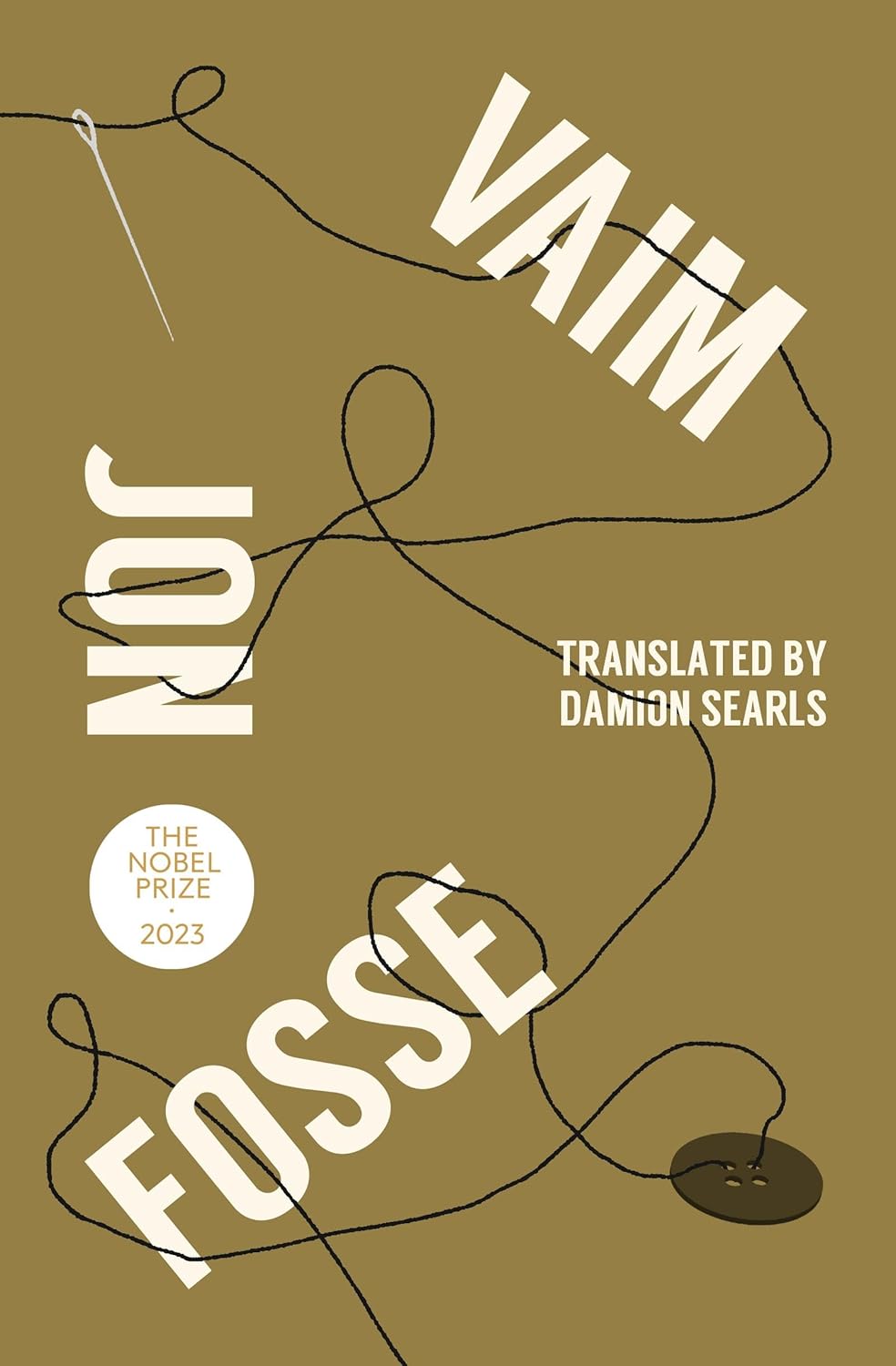
“All was strange,” thinks Olaf, one of the three main narrators in Jon Fosse’s new novel Vaim. He even considers engraving it on his tombstone but settles for “a cross and then Olaf.” Yes, Olaf, not Frank, the name his now deceased wife had insisted on calling him ever since their first encounter decades ago, for no apparent reason. Other characters too live by heteronyms, but their tombstones will invariably bear their birthnames. In this slim novel, daftly translated from Norwegian to English by Damion Searls, and Fosse’s first since his Nobel Prize, all is indeed strange.
Strange, because Fosse’s writerly vision is fierce in its metaphysical aim, and metaphysics transcends the limits of the sensible world. Strange, also, because the conditions of our time have ousted metaphysics from our discursive context, in this age obsessed solely with scientific and material progress, with economic competition. Fosse’s prose has surreal simplicity and playful repetition that transmute the unsayable into feelings we treasure. His writing, both in its content and linguistic ingenuity, provides hope that literature, so long as it remains a playground for metaphysics, will not be threatened by the preponderance of AI. Literature, empathetic in human pathos and metaphoric in its spirit, safeguards metaphysical truth central to human legacy.
*
In the fishing village Vaim, there lives a bachelor named Jatgeir, who describes himself as “a half-gray middle-aged man.” One day, he needs to buy a needle and a thread to sew back a loose button, so he drives his boat across the river to a city. A simple fisherman, Jatgeir is conned twice in a single day. Commiserating on his boat, which he named Eline in his youth, he sees a woman named Eline appear with a suitcase.
I think that it probably makes sense to hold out my hand to help Eline on board, and I hold out my hand and Eline grabs my hand with such feeling, so warmly, and it’s like the warmth from her hand runs through my whole body, in a way I’ve never felt before either, this warm feeling through my whole body was new to me, I think, and it’s a feeling I can’t name, it can’t be said in words (35)
Eline the person is Jatgeir’s “old secret love,” and Eline the boat is indeed named after her.
So, Jatgeir welcomes Eline into his house back in Vaim, and this is tragedy for Elias, the next narrator. Known by his neighbors as the prayer-house man, Elias is a solitary figure. His only friend has been Jatgeir, who does not visit anymore because Eline forbids it. Then one day, he hears a knock on his door, and it is Jatgeir, no longer flesh and blood anymore. Later, Elias learns that Jatgeir drowned earlier that day.
In the third and last part of the story, it is Olaf, an ex-husband of Eline, who reminisces on his past. He is 75 years old and lives in Jatgeir’s house, where he has lived after reuniting with Eline since Jatgeir’s death. Olaf also owns a boat, named Eline after his wife. At this point in the story, Jatgeir, Elias, and Eline are all dead, and Olaf is mulling over the design of his tombstone.
In Fosse’s fiction, time feels still. The metaphor “time is a river” would not fit in Fosse’s stories. Time is, rather, a picture. Once painted, it stays that way until time itself collapses. In our age of acceleration and fast communication, this stillness is a welcome reprieve. In stillness, we are able to reflect and contemplate. Yes, like a picture, the metaphysical truth that defines who we are will remain the same. It is often said that in the age of smartphones and AI, where people spend hours on screens and rely on information given by artificial intelligence, time is neither a picture nor a river but a set of scattered dots because we have lost that crucial anchor to reality, to the connectedness of things. It is to Fosse’s credit that through his ingenious use of temporal structure in his narrative, he grants us the view of one whole picture even though the events in the novel happen years apart.
So, it is when Eline comes in search of Olaf after Jatgeir’s death, she retorts once she enters Olaf’s shack after many years, “You haven’t changed a thing(!)”