
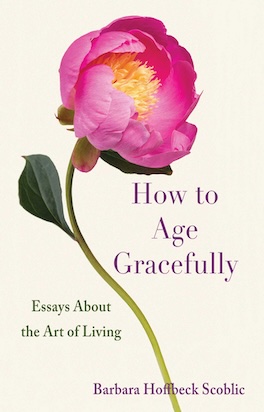
How to Age Gracefully: Essays About the Art of Living by Barbara Hoffbeck Scoblic. Published by She Writes Press.
Introduction
I ran up against my ignorance when as an undergraduate student I enrolled in Philosophy 101, read a sentence in my first assignment, and said to myself, “I know the meaning of that word and that word and that word, but in this sentence, all three of those words are in a row, and I have no idea what they mean when they’re in a row.” After a bit, I realized that I didn’t know what those three words really meant.
I had the same realization when I read the words “age gracefully” in the title of Scoblic’s book. We humans begin aging as soon as we’re born, but we don’t talk about children aging. We instead say, “They’re growing, they’re growing up, they’re becoming teenagers.” And “gracefully?” I can’t remember anyone saying, “Wow, that kid is aging gracefully.” Well, you might say — correctly, of course — that we more commonly use “aging” not just to mean getting older but getting old — and grappling with an aging body and mind.
As we get old, we have a choice. We can either stumble, or we can pirouette, to the end of the line.
In January 2026, about 67 million Baby Boomers (people born between 1946 and 1964) were alive — enough to fill an Amtrak train 12,000 miles long that would wrap halfway around the globe. Exactly where and when each of us will leave the Boomer Train depends on many factors, including our luck, health, social network, and financial circumstances. Because I was born in 1945, I am not an official Boomer, but for the purpose of this review, I consider myself to be an honorary Boomer and near the front of that train.
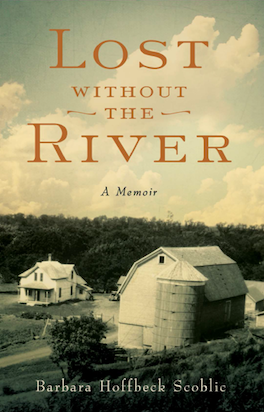
As Scoblic writes in her memoir, Lost Without the River (published in 2019), she was born and grew up on a small farm in northeastern South Dakota. After graduating from college, she joined the Peace Corps, served in Thailand, and traveled the world. She began her writing career as a reporter for The Argus Leader in Sioux Falls, South Dakota, and later moved to Manhattan, where she lived until 2022. Then, after falling twice, she moved into Brightview Woodmont, an assisted-living facility in downtown Bethesda, Maryland.
Throughout her travels, Barbara always carried her portable typewriter. Whether she brought that typewriter to Brightview, she doesn’t say, but within a year of living there, she began writing How to Age Gracefully. I call that a pirouette.
If you are reading this review, either you are on the Boomer train or know someone who is. You can consider Scoblic’s book an introduction to life and living in an assisted-living facility. The book includes sections on adjusting to a new place, a new body, and new people; a section on friends and community; and, of course, a section on the presence of death. Each of these sections includes several short chapters, some formatted in conventional prose and others formatted as a poem or dialog as in the script for a play.
Adjusting to a New Place
When Scoblic awoke on her third day at Brightview, after two restless nights and disturbing dreams, she writes, “I couldn’t eat, but I sat in the dining room, and I started listening to people. And, that same week, I began to write.” She learned about her fellow residents by overhearing their conversations and taking notes on her cellphone. “I didn’t have to eavesdrop: voices carry easily in the large dining room and in the hallways.” A few weeks after moving into Brightview, she “began to publish the conversations in the facility’s newsletter, and with that, people wanted to hear more!”
Brightview is in downtown Bethesda, and Scoblic sometimes sat on one of the benches outside near its entrance to watch the parade of people and dogs go by. When two women, one in her fifties and the other in her early twenties, asked her how old she was, she replied, “Eighty-three.”
“Eighty-three!” they said. “You’re the oldest person we’ve ever met.”
Scoblic writes, “The residents at my facility are tremendously accomplished people, but sometimes people can be rude or unkind.” They can be impatient, snarky, and take extraordinary license. In short, they can lack grace at times. When, as a newcomer, Scoblic was interrogated by a resident who asked her where she was from, what work she did before she moved into Brightview, what kind of writing she did, who her publisher is, and where reviews of her book were published, Scoblic excused herself after a bit more of that line of questioning and ended the interrogation by asking, “By the way, tell me, did I pass?”
Given Skoblic’s description of the facility, the residents, and her conversations with them, the residents are well educated and culturally sophisticated and have the means to live in Brightview. Residents celebrate Happy Hour, watch movies in an in-house screening room, and explore crafts. Scoblic tried knitting but soon realized that her craft is writing.
Adjusting to a New Body
Scoblic writes, “Getting used to our new, ailing bodies is one of the hardest parts of life here — none of us can fully accept that we’re no longer young and strong and full of force.” Growing up on a farm as she did, Scoblic was always physically strong. Now she misses walking, taking showers, and entering into the warmth of a home after being out in the cold. Not long after moving into Brightview, Scoblic developed severe bronchitis and was isolated in her room for three weeks while she recovered. When she was finally allowed to return to the dining room, she was found to have a fever, tested positive for COVID, and was quarantined to her room. She didn’t relish the isolation, but at least she could look out her window and be comforted by seeing something more essential to her than food: the sky.
At several places in the book, Scoblic reports that she had bad dreams — nightmares — with themes that reflect the reality of her aging: forgetting to put on a scarf and mittens when she walks out of the house in the winter; getting lost in the woods on a winter’s night; falling and injuring herself; and “thinking of old, infirm Inuit women who walk into the dark, cold night to their death to relieve their families of the need to feed her mouth.”
The changes in our bodies lead to decreasing independence and self-sufficiency. As growing children, we left home to go to school, spent hours out and about with our friends, got a driver’s license, and moved away from home. As we age, that independence is clawed back: losing our driver’s license, having to walk with a walker or cane, becoming forgetful, losing our memory, and being handled by so many people. At best, these losses are humbling; at worst, they are embarrassing, humiliating, or even dangerous.
Some residents keep to themselves, but others share their stories with each other or are self-appointed ambassadors who seek and welcome newcomers to Brightview. For example, Scoblic connected with three people who served in Thailand in the Peace Corps at the same time that she did; people from Manhattan who had traveled the same streets and avenues that she had; and a woman who had given birth to her daughter and son in the same hospital where Scoblic had given birth to her sons.
Moving from the comforts of home into a facility such as Brightview can be disorienting and, for some people, lead to loneliness, an especially isolating experience that can be life-ending. In the book section titled “Friends and Community,” Scoblic describes how “hard people work to find connections” with other residents and staff and to lean on each other. Residents share memories of their younger years and commiserate with each other, sharing the burden of aging and helping each other age gracefully. One resident confessed, “I must tell you how important all of you are to me.” Another said, “We seem to be having more and more old people here. Why do you think that is?” Another replied, “I think that’s because we care for each other.”
The Presence of Death
In the Introduction to the book, Scoblic wrote, “… everyone, regardless of age, lives in the presence of death — old people are just more honest about it.” In “The Presence of Death,” the last section of the book, Scoblic writes, “In an assisted living facility, death walks the halls with us from morning until night.” There are 911 emergencies, ambulances, and gurneys entering and leaving elevators. “We discuss death all the time, sometimes using black humor to cope.”
When a resident dies, the other residents lose not only their companionship but also that of the person’s friends and “children and grandchildren, who’d brought so much fun” when they visited. In one stretch of a few days, seven residents died. And then, Scoblic writes, “Before we knew it, seven new residents moved in.” Replacements keep coming and introduce residents to their friends and family members. And then there are new names to learn (and remember) and new life stories to hear.
Conclusion
I am 80 years old, and though I live independently, many of Scoblic’s observations ring true for me. For example, even though I am introvert, I was surprised when I retired at how much I missed the dozens of micro encounters with colleagues when I was working. I now crave human contact outside my home.
And now, as I approach the end of the line, I think much more about the limited time I have left on Earth, what my priorities are for my remaining days, whether what I am and do matter anymore, and what I can do physically and mentally to make my remaining days as healthy as I can. From my friends in the fitness center, the swimming pool, and the locker room, I know that others share my concerns and determination to remain physically and mentally healthy and productive despite the indignities of aging.
Scoblic’s book has given me a new perspective on what’s ahead for us Boomers.