
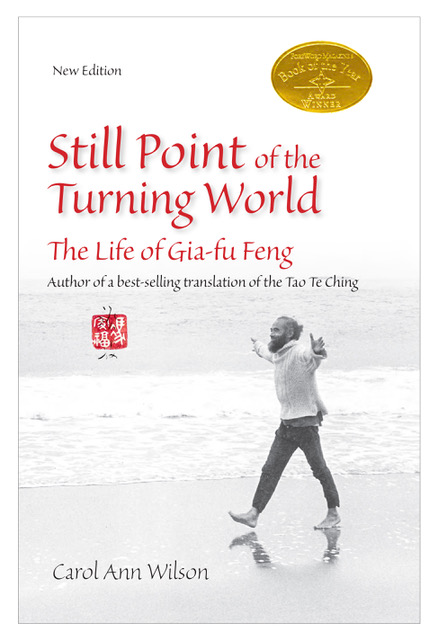
Still Point of the Turning World: The Life of Gia-fu Feng by Carol Wilson
In every biography, at least two people are involved. First, obviously, the individual who is the subject of the book, the person whose life we are about to enter.
But second—almost as important—is the biographer. Who is writing this book? What beliefs, motivations, and biases do they bring into it? And to what extent does their own construction of ideas and events help us understand another person’s existence, rather than obscure it?
Some biographers protect both their subject and themselves by writing a biography that is as objective and exterior as possible. They keep themselves rigorously out of the narrative, appearing only on the frontispiece and perhaps in the acknowledgements. Their work is honest and accurate—sometimes almost excessively so—relying heavily on documented facts and verifiable events. The result can be reliable, but also distant, even cold.
Other biographers, by contrast, step fully into the story. Sometimes far too fully. Their ego spills into the narrative, and the subject’s life becomes entangled with the author’s self-display. Everybody enjoys talking about themselves, and these writers cannot resist the temptation. The reader is left wondering: who, exactly, is the real subject here?
Carol Wilson strikes a rare and happy middle ground in her book on Gia-fu Feng. Passionate about Taoism, she is at once intrigued, and deeply engaged by Gia-fu Feng’s singular life. She evokes both the atmosphere and lived reality of traditional China and the devastation of the war with Japan, as well as the cultural landscape of America in the 1950s, 60s, and 70s. At the same time, she makes her own process visible, describing the difficulties she encounters, the doubts that arise, and the moments of understanding that gradually take shape.
By the end of the book, it is clear that the author herself has been transformed. She is reconstructing a life that is not her own, and she allows the reader to witness how this reconstruction unfolds, step by step. You are not merely receiving a finished narrative; you are participating in its making.
And speaking of transformations, there are, once again, two kinds of biography. One presents facts, laid out sequentially, one after another. It is a chronicle. There may be interesting episodes, but the structure remains linear and additive: one event follows the next, one period succeeds another.
Other biographies read as stories. In them, early events prepare the ground for later ones; nothing is accidental. The narrative is saturated with meaning. You observe a process of discovery and formation. You see, almost firsthand, how a person comes to recognize their own vocation in the course of living.
When Gia Fu is young in China, for example, he is deeply struck by the equanimity with which a woman he knows faces the death of her child. From her, he learns that even in the midst of profound suffering it is possible to remain centered, that not everything is lost. Through the immense upheavals endured by his country, and later through his encounter with the multifaceted and often bewildering culture of America, he comes to understand—just as the book’s title suggests—that there exists a still point of inner balance, something that remains unchanged amid the most violent transformations of the world and of our own lives.
The world turns; the still point remains serene and equanimous within our inner universe.
This biography tells such a coherent story. It is not merely a sequence of events, but the account of an extraordinary transformation: that of a man who moves from being a banker in China in the 1920s and 30s, raised in a traditional family of nine children, to becoming a Taoist teacher—humorous, unconventional, ever surprising, and persistently challenging—in the late 1960s and 70s.
It is a vast transformation, and Carol Wilson does it full justice.
The story begins far back, in Shanghai, when Gia Fu fails the examination that would have allowed him to become an engineer. In traditional China, when a father wishes his son to become an engineer—even though the son is drawn instead to literature and philosophy—and the son fails the exam, the path forward is narrow. In Gia Fu ‘s case, he became a banker.
All of this unfolds against the backdrop of the brutal war between China and Japan. Gia Fu flees to the free part of China and later, in 1947, emigrates to America to study international finance.
In time, he encounters the people connected with the American Academy of Asian Studies and the Esalen Institute, and he discovers that ancient Chinese philosophies such as Taoism and the I Ching are being rediscovered by avant-garde psychologists, poets, and philosophers. His life begins to appear governed by a series of providential accidents or synchronicities, in which he meets precisely the right people at precisely the right moment.
Gia Fu’s inner transformations are traced carefully, episode by episode. Among the most moving is his initial encounter with America: the acute sense of being foreign and unwelcome, and the oppressive presence of racism and nationalism. He experiences, in full force, the pain of dislocation and estrangement.
Another episode reverses this experience. In 1975, Gia Fu returns to China to see his family again. The country is no longer what it once was; the Cultural Revolution is at its height. Arriving with a flowing beard and dressed in red pants, he quickly realizes that perhaps he should conform, should try to look like everyone else.
When he meets his relatives—careful, guarded, measuring every word—he understands the extent of their suffering. His family’s collection of paintings, their library of seven thousand books, their precious vases: everything has been dispersed. The past has been systematically erased, at enormous cost. Yet there is a moment of grace: he discovers a natural affinity with a young niece, as rebellious and free-spirited as he himself is.
Equally compelling is Gia Fu’s gradual discovery of a cultural milieu in which he finally feels at home: figures such as Alan Watts, Kerouac, Abraham Maslow, Fritz Perls, and many others. One episode stands out in particular. In conversation with Kerouac about enlightenment, Kerouac describes his image of it as a painting he had seen in China Town of a young boy running with his fly open, urinating freely as he goes.
Freedom. Self-abandonment. Spontaneity.
Gia Fu laughs—and understands.
Feng is never presented as an idealized spiritual master. He emerges instead as a complex, often contradictory human being, shaped by loss, migration, and cultural rupture. His spiritual insight does not arise from withdrawal from the world, but from sustained engagement with suffering and impermanence. His work as a translator exemplifies what translation can truly mean: the removal of barriers, the creation of connection, and the possibility of deep inner change. He publishes a translation of the Tao Te Ching by Lao Tsu, and one of The Inner Chapters by Chuang Tsu, both with the splendid black and white pictures by Jane English.
In these chest-thumping times, when dictatorships flourish, brute strength is celebrated as a virtue, spiritual values are dismissed, and the milk of human kindness seems largely forgotten, an encounter with Taoism may be one of the most needed lessons. It is not quite a religion—perhaps it is better described as an attitude—that teaches humility and flexibility, that is gently ironic, and that reminds us we are part of nature, capable of learning from water, trees, wind, earth, and stars.
It offers a way back to inner stillness, whatever storms rage around us.
Carol Ann Wilson’s first book, Still Point of the Turning World: The Life of Gia-fu Feng, won Foreword Reviews Book of the Year Award in biography, and was a finalist for the 2010 Indie New Generation Award and the Colorado Author’s League Top Hand Award. Because We Wanted To!: Two women, a dream and a ranch called Singing Acres, another biography, was a finalist for similar awards. “The Girl from Coke,” a personal essay, appeared in the October 2020 issue of UNDER THE GUM TREE. You can also read her works of creative nonfiction at The Write Launch. Carol lives and writes in Boulder, Colorado.
The new edition of Still Point of the Turning World is now available on eheart.com and bookbaby.com; and by March 28th on Amazon.com. The original e-book is still available on Amazon.com.